The Clubhouse
What The Biggest Crowds In Non-League Football Have In Common


Every football club wants bigger crowds.
More supporters through the turnstiles means more atmosphere, more revenue and more opportunities to build lasting relationships with fans. Yet attendance growth remains one of the most difficult challenges in football. Clubs often look for a silver bullet, whether that is a marketing campaign, a ticket offer or a new signing capable of generating excitement.
The reality is usually more complicated.
The four highest average attendances in the Isthmian League during the 2025/26 season belonged to four very different clubs:
On the surface, these clubs have little in common. They operate in different communities, have different histories and attract supporters for different reasons. Yet each has succeeded in building crowds that many clubs at a higher level of the pyramid would envy.
The interesting question is not how many supporters they attract.
It is why.
Attendance is often treated as a reflection of results.
Win games and crowds increase. Lose games and crowds fall.
Results matter, but they rarely explain everything.
Dulwich Hamlet averaged 2,225 supporters throughout the season and exceeded 3,000 on multiple occasions. Chatham Town drew more than 3,000 for matches against Bromley, Dartford and Lewes. Folkestone Invicta regularly attracted crowds of more than 1,200 while Ramsgate, a club representing a town of around 42,000 people, averaged 1,236 supporters across the campaign.
That final figure is particularly striking.
A crowd of 1,236 represents almost 3% of Ramsgate’s entire population attending a home match on average. When you account for people who are not football supporters, children, away fans and those unable to attend, the proportion becomes even more impressive.
These are not isolated spikes driven by one-off events.
They are sustained attendances built over an entire season.
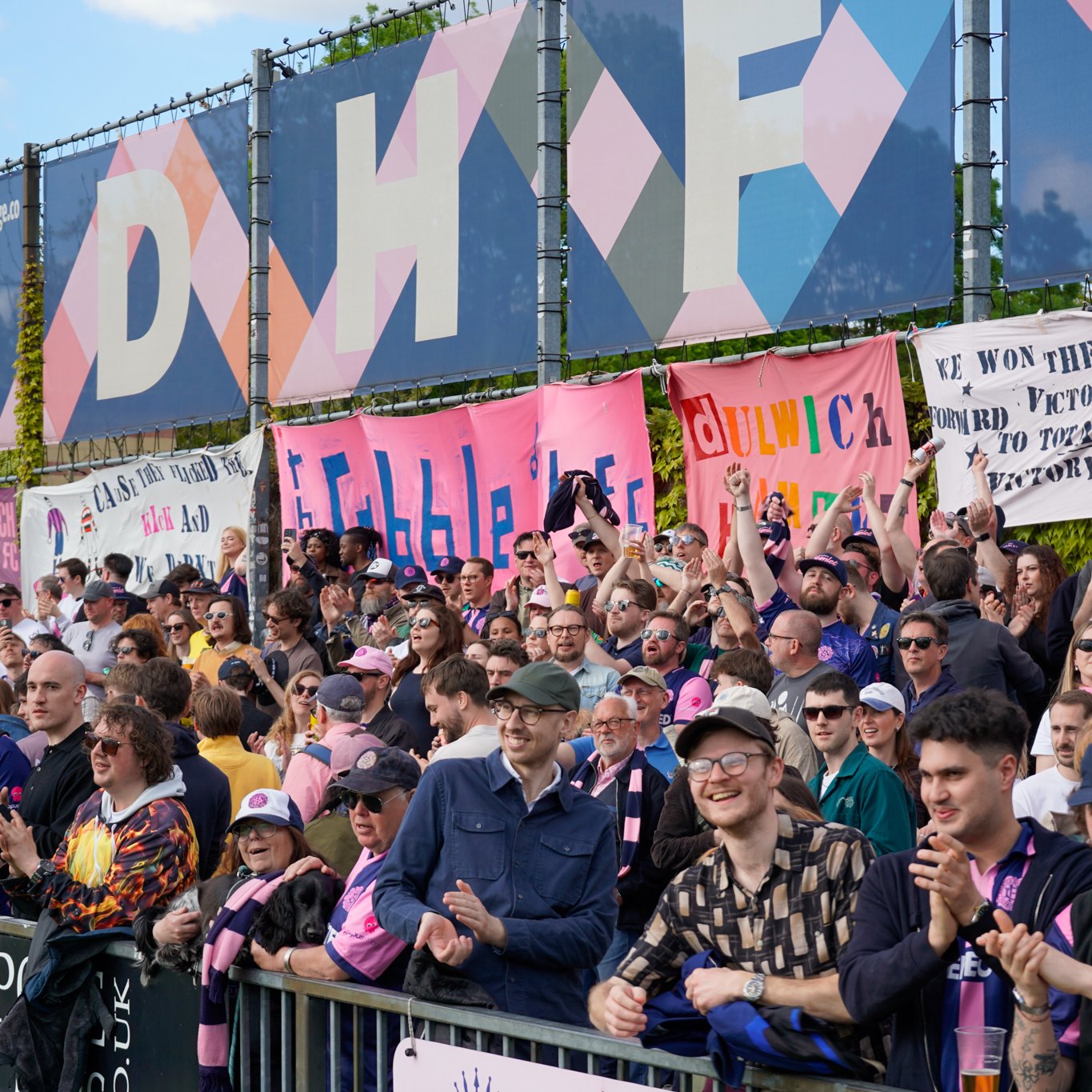
Few clubs in non-league football have created an identity quite like Dulwich Hamlet.
The club has become more than a football team. For many supporters, attending a match is as much about community, culture and belonging as it is about the result itself.
That matters.
When supporters feel connected to something larger than the ninety minutes, attendance becomes more resilient. The club becomes part of their routine and part of their identity.
The numbers reflect that connection. Dulwich averaged 2,225 supporters and regularly attracted crowds above 3,000. Those figures would not look out of place in League Two.
The lesson is not that every club should try to become Dulwich Hamlet.
It is that supporters are far more likely to attend when they feel connected to what a club represents.
Chatham Town offer a different model.
While identity plays an important role, their growth has been fuelled by visible ambition and a sense of momentum around the club.
Supporters want to feel that they are part of a journey. They want to see progress, investment and a club that is moving forward. Chatham have successfully created that feeling.
The result is an average attendance of 1,448, with several crowds exceeding 3,000 during the season.
Importantly, those bigger attendances are supported by a strong baseline. Many clubs can generate interest for a marquee fixture. Far fewer can consistently attract more than 1,000 supporters throughout a campaign.
The challenge for clubs is not creating one big crowd.
It is creating the conditions for the next one.
If Dulwich represents identity and Chatham represents momentum, Folkestone Invicta demonstrate the value of consistency.
Their attendance figures reveal something that is often overlooked in football.
Habit matters.
Many of Folkestone’s home matches attracted crowds between 1,100 and 1,400 supporters. There are no dramatic peaks and troughs. Instead, there is a reliable base of supporters who continue to turn up week after week.
This is how sustainable attendance growth happens.
Supporters do not need to be convinced every Saturday. Attending becomes something they simply do.
Football clubs often focus on attracting new fans, but retaining existing ones is equally important. Consistent attendance is usually the result of hundreds of positive experiences accumulated over time.
The strongest supporter relationships are rarely built in a single moment.
They are built through repetition.
Ramsgate’s story may be the most remarkable of all.
With an average attendance of 1,236, they sit fourth in the Isthmian League attendance table. Yet their population is significantly smaller than many clubs competing at the same level.
What Ramsgate demonstrate is the power of community connection.
Football clubs often talk about being at the heart of their community. Ramsgate appear to have achieved exactly that.
Their biggest crowds exceeded 2,000 supporters, but what stands out is the consistency beneath those headline numbers. Week after week, supporters continue to show up.
That is not a marketing achievement.
It is a community achievement.
When a football club becomes woven into the fabric of a town, attendance becomes less dependent on results and more dependent on belonging.
The most interesting conclusion from the attendance data is that there is no single formula for success.
Dulwich Hamlet, Chatham Town, Folkestone Invicta and Ramsgate have arrived at similar outcomes through different routes.
One has built a powerful identity, one has built momentum. One club has built habit, another relies heavily on community.
Yet there are common themes running through all four clubs.
They communicate consistently. They make attending easy. They give supporters reasons to feel connected beyond matchday. Most importantly, they understand that attendance growth is rarely about selling a ticket.
It's about building a relationship.
Football clubs often ask how they can sell more tickets. The clubs attracting the biggest crowds in the Isthmian League appear to be asking a different question entirely.
How do we become more important to our community?
Attendance is the outcome of answering that question well and the evidence is there in the numbers.
Dulwich Hamlet averaged 2,225 supporters. Chatham Town averaged 1,448. Folkestone Invicta averaged 1,328. Ramsgate averaged 1,236.
Different clubs, different stories and different strategies. But, at the end, the same result.
And perhaps that is the most important lesson of all. The biggest crowds in non-league football are rarely built through a single campaign or promotion. They are built through creating a club that people genuinely want to be part of.