The Clubhouse
How FC United of Manchester Are Growing Without Losing What Makes Them Different
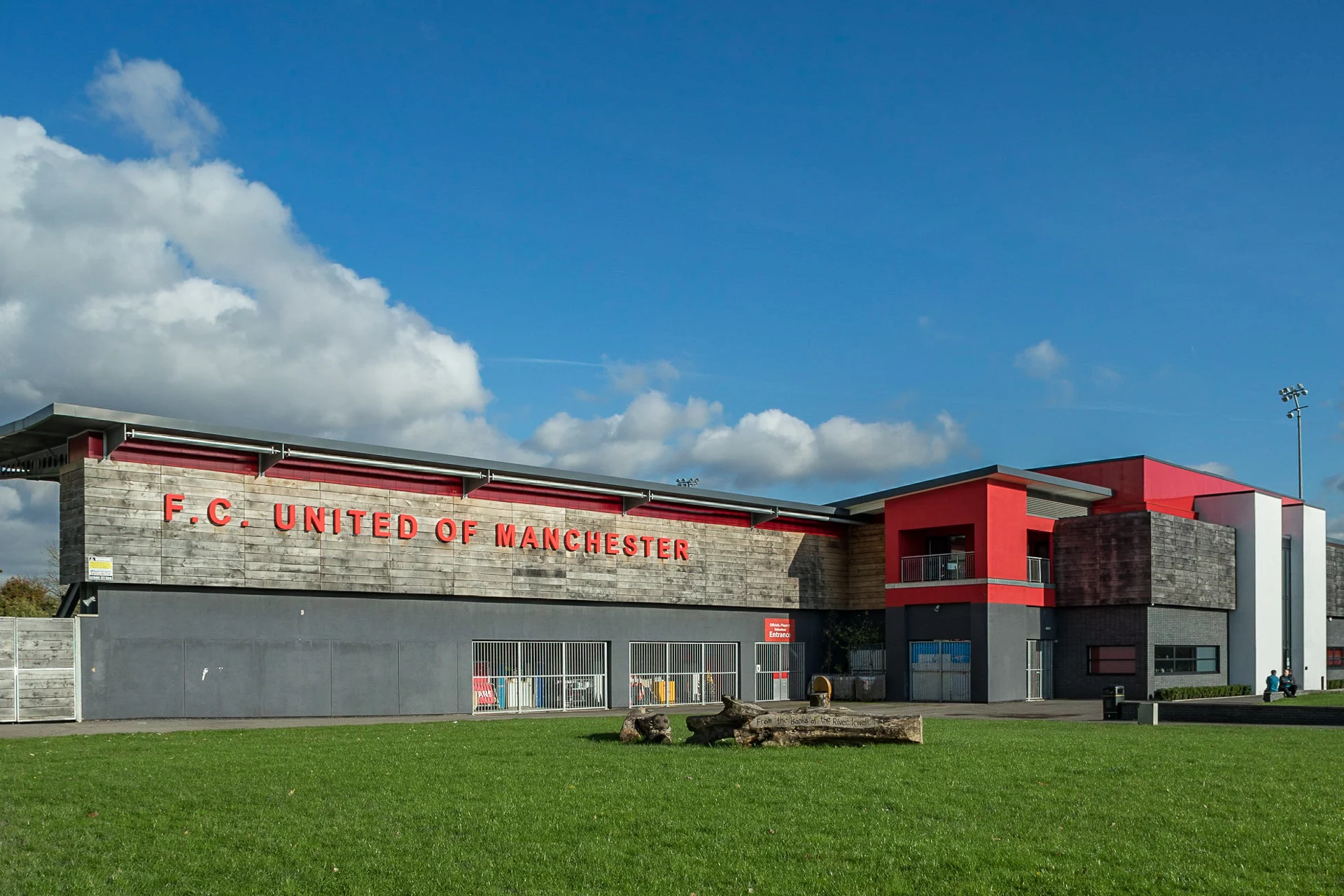


How digital ticketing helped FC United capture growing demand, increase fixture and season-ticket revenue, and create more time for the community work at the heart of the club.
FC United of Manchester have never been especially interested in following the conventional football blueprint. Founded in 2005, the club emerged from a belief that football should belong to the people who support it, and 21 years later that principle still runs through Broadhurst Park. FC United remain 100% fan-owned, with approaching 2,000 co-owners, each part of a structure designed to keep supporters at the centre of the decisions the club makes.
The phrase most associated with the club, “making friends, not millionaires”, captures something important about what FC United have become, but it can also make the idea of growth seem more complicated than it really is. A football club committed to community ownership still needs to sell more tickets, generate more revenue and operate efficiently. In FC United’s case, doing those things well matters precisely because money is not the ultimate purpose of the organisation.
Between the 2024/25 and 2025/26 seasons, FC United increased fixture and event revenue by 53%, while fixture and event sales grew by 12%. Season-ticket sales increased by 45%, with season-ticket revenue rising by 138% over the same period. Those figures tell an impressive commercial story, but they become more meaningful when viewed alongside the broader role FC United play in their community and the different way the club measures success.
There is an obvious footballing measure of success at any club. Supporters want their team to win games, challenge for promotion and progress as far as possible, but at FC United the definition has always extended beyond the league table. Nigel Brookes, the club’s Operations Manager, explains that simply continuing to exist on their own terms, year after year, is itself an important measure of success for a supporter-owned organisation.
That sense of purpose is reflected in what happens around Broadhurst Park away from the first team. FC United estimate that their work generates around £1.8m of social and community value every year, much of it in north Manchester. The club runs free sessions for schoolchildren, supports activities for older people and people with mobility issues, works with health and wellbeing programmes and uses its facilities for a range of community initiatives. Broadhurst Park is not simply somewhere supporters arrive every other Saturday. It is intended to function as a community asset throughout the week and throughout the year.
Nigel sums up that way of thinking simply:
“It’s a massive (community) impact, so that’s winning.”
That philosophy changes the context in which revenue growth should be understood. More sustainable income gives FC United greater freedom to invest in their facilities, support community programmes, broaden the use of Broadhurst Park and continue operating without becoming dependent on an individual benefactor. Commercial growth and community purpose are not competing ideas here. One helps sustain the other.
FC United’s growth over the past two seasons has not come from one intervention, and the club are clear that better performances on the pitch increased demand. As results improved and certain fixtures began to look busier, or even like potential sell-outs, supporters who might previously have paid cash or card at the turnstile increasingly began buying before matchday instead.
That shift helped change behaviour. For some supporters, buying a ticket for a busy fixture became their first experience of purchasing digitally from FC United, and the response the club received was encouraging. Office Manager Nadim Hammad recalls supporters coming back to them after using Fanbase for the first time and saying:
“The amount of feedback we had is just bought a ticket for the first game on Fanbase, that was so easy.”
Once supporters had experienced the process, purchasing digitally became much more normal. That reduced reliance on pay-at-the-gate sales, eased pressure around the turnstiles and gave FC United a clearer idea of likely attendance before matchday. It also meant that demand created by performances on the pitch could be captured earlier, rather than leaving every sale dependent on somebody physically arriving at Broadhurst Park.
There was a less obvious commercial benefit too. Nadim estimates that, over FC United’s time using Fanbase, the club may have captured around £10,000 in revenue from people who bought tickets but ultimately did not attend. Under a pure pay-at-the-gate model, those missed visits would also have meant missed revenue. With advance purchasing, the sale has already happened.
For a club operating on relatively tight margins, those changes matter. They make matchday revenue more predictable, remove some of the uncertainty around walk-up sales and allow staff to understand demand before the gates open.
The results can be seen in FC United’s year-on-year figures. From 2024/25 to 2025/26, fixture and event sales increased by 12%, while revenue generated from those sales increased by 53%. Season-ticket sales increased by 45%, accompanied by a 138% rise in season-ticket revenue.
It would be too simplistic to attribute those increases entirely to the ticketing platform, particularly when FC United themselves point to improved performances on the pitch as one of the reasons demand increased. The more useful way to understand Fanbase’s role is that the platform helped the club capture that demand more effectively.
Instead of additional interest simply creating longer queues, heavier turnstile traffic and more administration, an increasing proportion of supporters are arriving with tickets already purchased and stored on their phones. FC United can see more of their expected attendance in advance, supporters have a straightforward route to purchase and the operational team has fewer manual transactions to deal with on the day.
Nadim describes the club’s experience with Fanbase as:
“Fantastic customer service, tailored to our club – delivering an easy to operate platform to record match data entry and enhance our engagement with supporters.”
He has also previously said:
“We felt Fanbase – and those involved – understood our club and the level we operate at. The value for money was good.”
For a club where people regularly have responsibilities across several different areas of the operation, the value of removing unnecessary work is significant. The objective is not to digitise something for the sake of it, but to make routine parts of running the club easier so that time can be spent elsewhere.
That operational side of the relationship becomes particularly important on matchday. Football clubs have finite capacity, and every manual reconciliation, turnstile payment or technical issue consumes time that could have been used somewhere else. As more supporters have adopted digital tickets, FC United have been able to make their matchday process more predictable, scanning supporters into the ground rather than relying as heavily on transactions at the gate.
Nigel’s experience also underlines the importance of support for clubs without large internal technical teams. He recalls an issue over the summer when several devices appeared to have dropped off the club’s scanners. After contacting Fanbase support, he was taken through the problem and had it resolved before the start of the season.
His assessment was straightforward:
“I can’t fault it really.”
That may sound like a small part of the overall story, but for clubs operating with limited staff and limited time, reliability and access to support are part of what makes digital adoption workable in practice.
FC United have also used digital ticketing as part of a more imaginative approach to bringing new supporters into Broadhurst Park. When Manchester United were playing at home on a Sunday, one of FC United’s volunteers contacted Manchester United supporters’ branches across Europe, inviting travelling fans to attend FC United on the Saturday before heading to Old Trafford the following day.
The invitation included a direct link to purchase through Fanbase, and the club subsequently noticed groups travelling from Norway, Germany, Ireland and elsewhere. For visiting supporters who were already organising flights, accommodation and match tickets digitally, buying an FC United ticket online was arguably more natural than arriving in Manchester and working out how to pay at the gate.
It is a useful example of where growth can come from further down the football pyramid. Clubs do not always need to create completely new demand. Sometimes the opportunity is to make it easier for people who are already interested in live football to discover another fixture, make a decision and buy a ticket while that interest is there.
The next opportunity for FC United lies in what happens after the purchase. The club now has nearly 1,500 active purchasing supporters represented within its Fanbase data, creating a much clearer picture of who is attending Broadhurst Park and how those supporters interact with the club.
FC United openly acknowledge that there is more they can do with that information. Nadim describes supporter engagement as one of the areas in which the club has yet to take full advantage of the system, not because there is a shortage of ideas, but because finding the time and resource to execute them consistently is difficult.
That creates the next stage of the relationship between the club and its supporters. Rather than treating the ticket as a transaction that ends when somebody passes through the turnstile, FC United can begin using purchasing and attendance information to communicate in a way that is more relevant to the person receiving it.
That could mean something as simple as thanking supporters after a game and wishing them a safe journey home, promoting a post-match manager interview to people who have actually attended, or using attendance patterns to communicate upcoming fixtures to supporters most likely to be interested. Over time, the same data can also help the club understand who is attending regularly, who has stopped coming and who might be ready to move from occasional tickets towards a season ticket or membership.
For a club built around supporter ownership, there is a natural fit in using data not simply to sell more aggressively, but to build a better relationship with the people already choosing to spend their time at Broadhurst Park.
That wider relationship becomes even more important as FC United consider how Broadhurst Park can be used beyond first-team football. The men’s team occupies the stadium for only a relatively small number of days each year, and the club are exploring ways to make greater use of the asset through conferences, academy activity, community programmes and potentially larger events or concerts.
For a fan-owned club without an individual owner underwriting losses, diversification matters. Every additional use of the stadium creates an opportunity to generate income, make better use of existing facilities and strengthen the relationship between FC United and the surrounding community. It also makes the club more resilient when football inevitably produces fluctuations in attendance, performance and revenue.
The principle beneath all of that remains remarkably close to the one FC United were founded with. Nadim describes the club’s position this way:
“We are modern football. That’s the way football should be. It should be reactive to its community. That’s where it should be focused.”
FC United’s recent growth is significant because it has not required the club to move away from that idea. More supporters are purchasing digitally, fixture and season-ticket revenues are growing, matchday operations are becoming easier to manage and the club is building a larger, more useful understanding of the people coming through its gates.
The technology is not the story in itself. Its value is in making the club more efficient, giving staff more visibility and helping FC United capture more of the demand they are creating, while leaving more time and resource for the things the club ultimately exists to do.