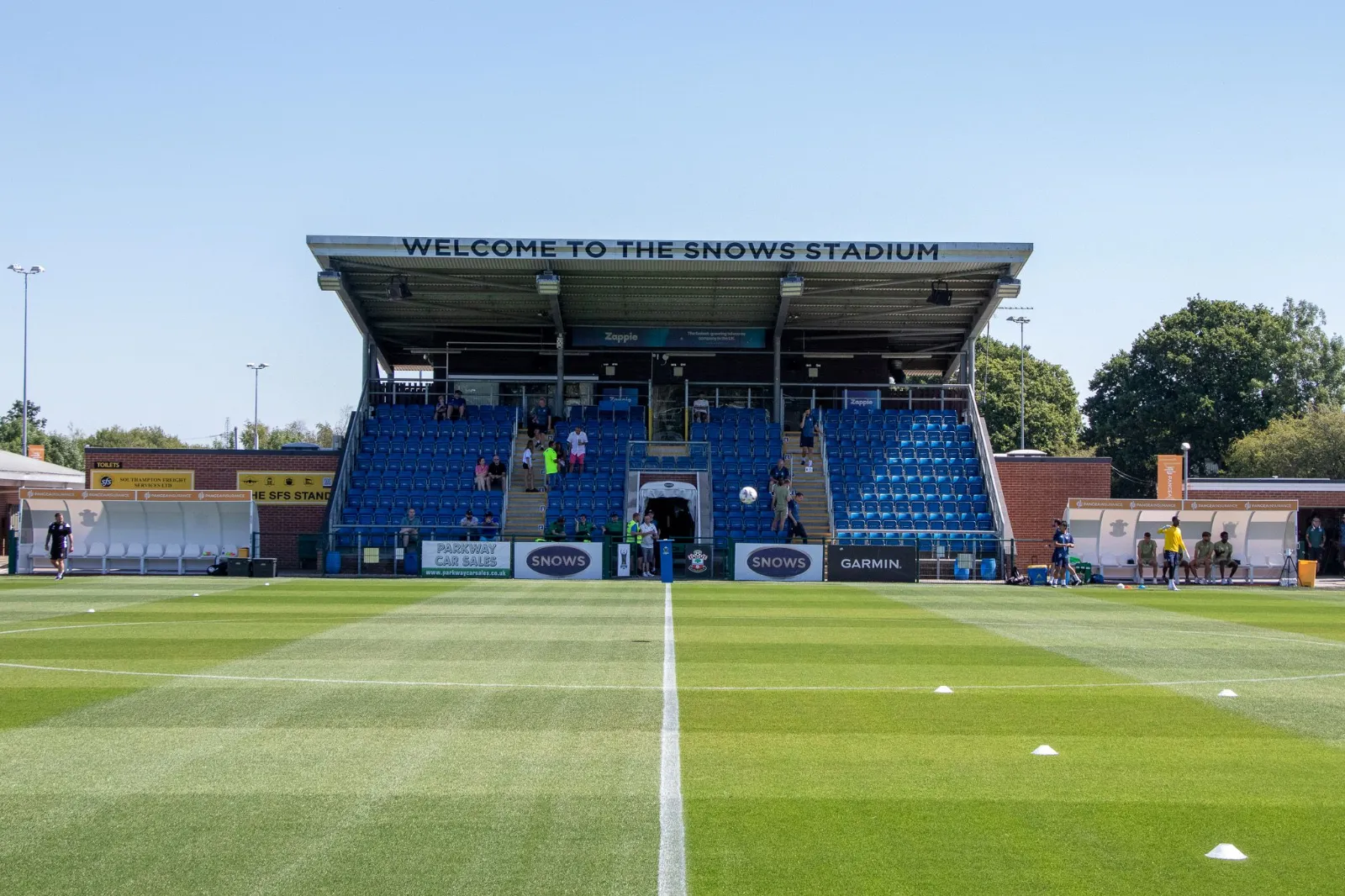
Harry Hugo has taken Farnham Town from crowds of around 50 to 1,500, overseen three consecutive promotions and transformed the club’s commercial operation. But the former Goat co-founder is already planning for the day the results turn. He speaks to Fanbase CEO Alasdair Crawley about attracting new supporters, building a commercial operation that can stand on its own and creating a football club people want to stay part of.

When Harry Hugo and a group of friends took over Farnham Town four years ago, the club were in the ninth tier of English football, attracting around 50 supporters and generating roughly £50,000 a year in revenue, much of it from selling the car park. In 120 years they had never played any higher. Harry had built and sold Goat, which grew into the world’s largest influencer marketing agency before WPP bought it in 2023, and Farnham was a homecoming, the club he’d played for as a boy and the town where he went to school.
Today Farnham average crowds of 1,500, generate more than £1.3 million a year and play in the National League South after three promotions in three seasons. It’s a remarkable transformation, but Harry is already looking past it. By his reckoning, around 97% of Farnham’s supporters are new, and many of them have barely seen the team lose. “You may have been a fan of Farnham Town for three years and you may have only seen Farnham Town lose seven league games,” he says. “That is not a healthy way to become a fan when your expectation is that we just win.”
He knows a losing run will come eventually, and he’s clear about what it will test. “How can I turn my 1,500 fans, fans of winning, into fans of Farnham?” he asks. It’s a question every growing club has to face sooner or later, and the things Farnham have built over the past four years are, in effect, their answer so far.

Farnham’s starting point was the problem facing almost every club below the Football League, which is persuading people to try it at all. “It’s difficult to get people to pay 20 quid, 15 quid, 10 quid, whatever, to go to non-league football when they’ve never been to non-league football before,” Harry says. His answer was to give season tickets to local youth teams, affiliate clubs and other sports clubs in the area, around 1,500 a season for three years, on the basis that a good first experience would do the selling. “If I get someone down to Farnham Town and they don’t pay and the next time they have to pay £10, they’re going to think it’s cheap, because they just had a great time.”
The approach has evolved as Farnham have climbed the divisions. The club now offer a full 23-game season ticket alongside a second tier that gives the same community groups free access to 12 fixtures. Those supporters can upgrade to the full season for £70 to £80, compared with a standard price of around £240. It’s a model that retains the original invitation to come and experience Farnham, while creating a route towards paid attendance.
Harry is equally clear that none of it works if the matchday isn’t ready for the people it attracts. “You have to make sure that you’re serving beer quickly at a good price. You have to make sure that your food is good. You have to make sure your ground is clean and nice, especially in the first 30 to 60 seconds of someone walking into the ground.” A new audience also brings different expectations, and he gives the example of a mother bringing her ten-year-old daughter to a game for the first time. “What are the women’s toilets like, that you’ve never had to think about because there’s only four women that come to the games? If they have a great time but the women’s toilets are horrendous, they aren’t going to come back. That’s going to be the thing they remember.”
Getting someone through the gate once is one thing, and giving them a reason to put the next game in the diary is another. Farnham’s answer has been themed matchdays, including Oktoberfest and St Patrick’s Day, which turn a fixture into an occasion. For Oktoberfest, the club brought in an oompah band, Bavarian tables, German beer, pretzels and bratwurst, and served drinks in two-litre plastic steins. “It’s a festival vibe for four or five hours rather than a football game,” Harry says. “That gets people in earlier and staying later and drinking more.”
The numbers made the case. The club spent around £1,500 on the band and £1,000 on steins, and Harry says they “made like 30 grand that day”. But the more important effect is on habit, and on giving people a reason to come that doesn’t depend on the opposition or the league table. “Why have you got it in the diary? Oh, it’s because it’s Farnham Town’s Oktoberfest. It was really good last year.”
The most distinctive part of Farnham’s approach is how much Harry shares. The club have released an hour-long documentary every week for four years, more than 200 hours in total, including every pre-match and half-time team talk, with the manager miked up on the touchline. Harry also posts detailed figures on revenue, ticket sales and individual initiatives, an approach he took at Goat, where he vlogged every day for 450 days. He sees it as a way of reaching people who would never otherwise care about Farnham Town. “Non-league football only has a certain audience,” he says. “But almost 100% of football fans are interested in football finance, or how it works, or little titbits behind the scenes.”

He accepts that some of what he shares is mundane, like the 600 portions of chips sold at one game, but says that’s precisely why it lands, given how little the rest of football reveals. More importantly, it gives people something to follow that isn’t just the result. “People buy into human stories much more than they buy into a crest telling a story,” Harry says, and he thinks many clubs avoid putting anyone in that position because they’re nervous of the consequences. “What lots of football clubs are really scared of is having a figurehead that is above the parapet, because if you’re above the parapet and it’s going badly, then you can get shot at.”
That audience reaches well beyond Farnham’s own supporters. Harry describes a Havant & Waterlooville fan following the club for the first time out of curiosity. “They’re probably never going to come to the game, but they’re going to watch the content. That’s great for us.”
The one lesson Harry says Farnham learned the hard way is that off-field success can’t be separated from what happens on the pitch. In the first 18 months, the club’s best commercial ideas kept coinciding with defeats, and they found themselves unable to talk about them. “You can’t spend the next week going on about how good you were at selling burgers,” he says.
Looking back, he thinks staying quiet was the wrong response. “You can’t just be transparent in the good times,” he says. “When we lost and we did something off the pitch that was good, we wouldn’t talk about it at all. You can still talk about it. I just think you can’t bang on about it.” His instinct, he says, would be to address a bad result head on and let the mood settle for a day or two before turning to anything else, an approach that matters more as Farnham move up into a division where heavy defeats are much more likely.
“You can’t spend the next week going on about how good you were at selling burgers.”
Harry Hugo, Owner, Farnham Town
Harry is open about what all of this rests on. Asked about the regulator’s finding that many clubs would quickly collapse without their owner’s money, he says Farnham “definitely fit into that category” as things stand. “Is Farnham run sustainably? No, right now it is not, because I’m trying to win leagues and get promoted and build infrastructure.”
He’s equally clear that Farnham could now operate sustainably at their current level, provided he was willing to scale back his ambitions. “Could Farnham be sustainable in the National League South? Yes, absolutely. I could stop building infrastructure right now and we’d be fine.” That would mean a smaller playing budget and a team fighting nearer the bottom than the top, but it’s a long way from the club he inherited, which he says “couldn’t even get near being sustainable” at step five. Farnham can now sustain a playing budget nearly ten times larger, alongside 20 to 30 paid matchday staff, because Harry decided early on to run the club as a professional business rather than rely on volunteers. The difficulty is that he doesn’t want to stop. “Ultimately I want to win,” he says, “and that costs money.”
Harry has shown he can attract attention, bring thousands through the gate and get people across the country following a club that barely registered four years ago. What he hasn’t yet had to discover is how many of those supporters will keep coming when the winning stops. That’s when the value of everything Farnham have built away from the pitch will become clear.
“At some point we will just go on a run of losses, and then it’s about managing that expectation and building a fan group that thinks in a different way to how it thinks currently,” he says. “How many people turn up, especially when it’s cold, when it’s February? That’s my next big challenge, when we become a normal football team and not the team that we are right now.”
One practical idea for your club, every fortnight. No spam, unsubscribe any time.
You've made the team sheet.
The next issue of the Clubhouse lands in your inbox soon.
Missed the target.
Check your email address and have another shot.
Read by club owners, commercial teams and ticketing managers.