The Clubhouse
Why Brentford Chose to Document Its Away Support
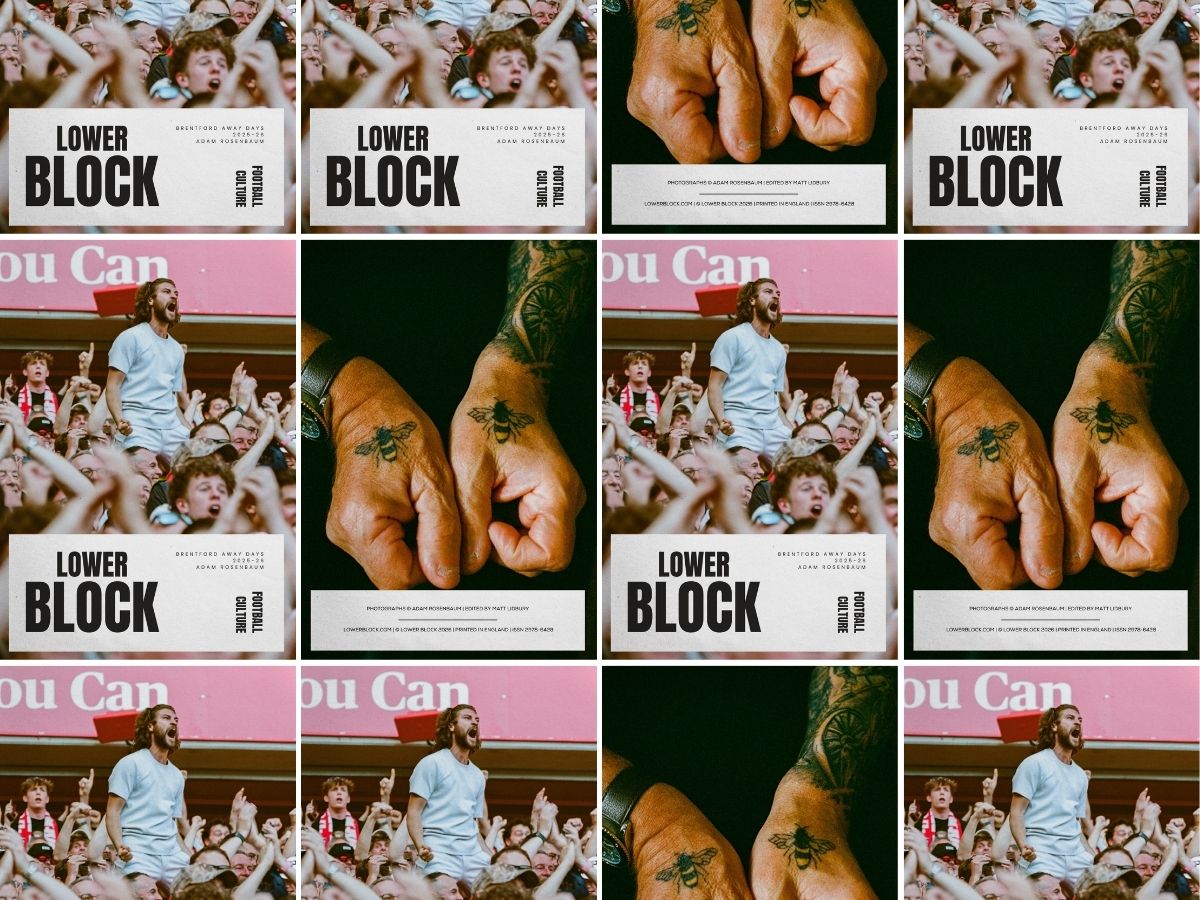


Football clubs are constantly being told to find new audiences. Reach younger supporters. Grow internationally. Build bigger social followings. Turn casual fans into customers. All of that matters, but there is another question that is often less fashionable and arguably just as important: how do you make the people already supporting your club feel closer to it?
That was, in a roundabout way, what sat behind Brentford’s decision to work with Lower Block on a photography project documenting the club’s away support. Lower Block has spent years documenting and curating photography around football culture as it exists beyond the 90 minutes. Its zines are full of train stations, pubs, streets, clothes, food, faces and all the other details that supporters recognise instantly because they are the things that make up a matchday. Brentford had seen that work already. Someone within the club’s marketing team had bought a previous Lower Block Edition, understood the style and approached Lower Block with a relatively simple brief.
“They wanted to show the diversity of their fanbase, the community of the travelling fans and what an away day looks like,” Lower Block founder Matt Lidbury explains. “Ultimately, it was also about showing that you can be part of this away day as well.”
There was a practical reason for that. Brentford wanted to encourage more supporters to travel, but both sides understood that a photography project was not suddenly going to add thousands of people to an away allocation. The point was subtler than that. It was about showing what already existed around following Brentford away from home and making that world feel visible, attractive and accessible to people who might not yet see themselves as part of it.
That meant the project could not simply become another piece of polished club content. Lower Block’s photography has always been interested in the less controlled parts of football culture, and the job was to find a version of that which still felt truthful while naturally fitting within a club partnership. The resulting work captured a broad cross-section of Brentford’s travelling support. Families, younger supporters, older supporters and disabled fans appeared alongside the groups of friends and more recognisable terrace subcultures that are often associated with away days.
“You want to show all of it,” Lidbury says. “There’s the supporter in a wheelchair, there’s the mum and dad with their daughter, and then you’ve got your Stone Island-wearing crowd. That is what the support actually looks like.”
The photographer mattered too. Lower Block's role included identifying the right photographer to interpret that brief. Adam Rosenbaum, who shot the project, is himself a Brentford season ticket holder and follows the club home and away. For Lower Block, that was more than a convenient detail. It meant the person behind the camera understood the rhythms of the club without needing to be told where to stand, what mattered or what might feel forced.
“It was almost a match made in heaven,” Lidbury says. “Adam has followed Brentford his whole life. If I couldn’t have got Adam and had to use someone who wasn’t a Brentford fan, it would have changed the dynamic slightly.”
Brentford commissioned Lower Block to produce the work and was given access to selected imagery for its own channels, but the publication itself remained under Lower Block’s editorial control. That balance is probably central to why the project worked. The club may have helped fund it, but it did not try to turn it into a brochure. Lower Block was able to make something recognisably its own, rather than something that merely borrowed the visual language of independent football culture.
For clubs, there is a wider point in that. Supporters are usually very good at recognising when they are being marketed to. The easiest way to make something feel authentic is rarely to spend more time discussing authenticity in a meeting. It is to work with people who already understand the culture and give them enough freedom to document it properly.
The physical format is important too. Football marketing has become overwhelmingly digital, and understandably so. Clubs are expected to feed an endless mix of Instagram, TikTok, YouTube, email and app content. Yet Lower Block’s work deliberately goes in the opposite direction. Its publications are small, affordable and designed to be kept, collected or physically shared. They are closer in spirit to the old football programme than a premium coffee-table book, something that can fit in a back pocket, sit on a shelf or be handed to somebody else.
That permanence gives the photography a different value. A social post might live for a day. A video may disappear down a feed within hours. A physical photograph of a pub, street or familiar face can become more meaningful as the years pass.
“Great photography documents all the stuff around football,” Lidbury says. “You can look back at a picture in 10, 20, 30 or 40 years and think, ‘I used to go to that shop with my grandad’, or, ‘That’s where we used to get a beer before the game.’ It almost immortalises those things.”
Those details can look insignificant when viewed from inside a club office. They are not insignificant to supporters. Matchgoing fans know which train they catch, where they meet, where they drink, which shop they stop at with their kids and which faces they expect to see every other Saturday. These are the parts of football that are difficult for an owner, investor or marketing department to manufacture because they do not belong to them in the first place.
“A lot of matchgoing fans rightly feel like it is their club,” Lidbury says. “Owners are custodians. The fans are the lifeblood. The owner doesn’t know the pub landlord’s name or the shop you get your sweets from before the game with your kids. That belongs to the supporters.”
It is here that the Brentford project becomes more interesting than simply a well-shot zine. Clubs at every level are trying to work out how to derive more value from their existing audiences. That can sound cold when expressed purely in commercial language, but the two things do not have to be in conflict. Making supporters feel more connected to a club can also make them more likely to attend, travel, buy merchandise, arrive earlier and spend more around matchday.
The distinction is in the order those things happen.
“If you’re looking to sell more to your fanbase, whether that is tickets, shirts or even beers at the ground, something like this can support that,” Lidbury says. “Someone sees a shirt photographed in the right way and thinks, ‘Actually, I haven’t got that. That looks great.’ Or they see the away day and think, ‘I want to be part of that.’”
The photography is doing commercial work, but it does not feel like an advert because selling is not its primary purpose. It is first showing people something they recognise or something they want to be part of. That connection then has value.
This is increasingly relevant for clubs outside the very top of the game. Much of the traditional conversation around football growth has been about acquisition: how do we find more fans? For many clubs, there is now just as much opportunity in asking how they can build deeper relationships with the supporters they already have. A club does not necessarily need another 100,000 social followers if it can persuade more of its current supporters to attend another game, take an away trip, buy a shirt, join a membership scheme or spend more time around the ground.
None of that requires a club to invent a culture. In fact, trying too hard to invent one is usually where things start to go wrong.
Every club already has stories, rituals and identities sitting in plain sight. At some clubs that might be thousands of supporters making a Premier League away trip. At another it could be a few hundred people standing behind the same goal at a non-league ground every Saturday. The scale is different, but the emotional value is not necessarily smaller.
Lower Block’s approach is deliberately accessible in that regard. The zines are not positioned as luxury objects and the production itself does not need to be prohibitively expensive. The emphasis is on good photography, strong editing and keeping the format simple.
“Affordability and accessibility are really important to me that in essence is what football should be,” Lidbury says. “You can produce something for your fans that is pretty cost effective and they will like it. It does not have to become this huge expensive project.”
There is also something valuable in a club allowing its story to sit within a wider football culture rather than only inside its own channels. Lower Block publications have found their way into independent shops and spaces in places including Tokyo and New York. A Brentford supporter may primarily want the Brentford edition, but the publication itself sits alongside work about clubs and football communities from elsewhere in England, Italy and beyond.
For smaller clubs in particular, Lidbury believes there is value in simply being represented within that broader world.
“It is nice for supporters to feel like their club is being looked at by a publication like Lower Block,” he says. “It is almost saying, ‘We’ve been seen here. We’re part of this football culture as well.’ Sky might not be giving that club the same care or attention, but that doesn’t mean its culture is any less interesting.”
That feels like the real takeaway from the Brentford project. Football clubs will always need to look outward and find new supporters, but there is a danger in becoming so focused on the next audience that the existing one becomes background scenery.
The people making the journeys every week are not simply customers at the end of a ticketing funnel. They are part of the product, part of the atmosphere and part of the identity the club ultimately presents to the wider world.
Brentford did not need to create that culture. The travel, pubs, friendships, shirts, routines and away days were already there. What the club did was recognise that those things were worth documenting.
For other clubs, that may be the more useful starting point. Before asking how to build a stronger community around your club, spend some time looking at the community you already have.
You can see Lower Block's collaboration with Brentford here.