The Clubhouse
The Power of the Mascot: How Sports Clubs Are Finding Fans Beyond the Game


There was a time when the job description for a sports mascot was fairly straightforward. Turn up on matchday, wave at the children, pose for a few photographs and, if the opportunity presented itself, make a nuisance of yourself in front of the opposition supporters. You might be asked to take part in a half-time race or dance badly to whatever was playing over the stadium speakers, but nobody was particularly concerned about your contribution to the club's wider commercial strategy.
That arrangement suited everyone perfectly well. Mascots were part of the furniture, an enjoyable bit of nonsense that helped make attending a match feel like an occasion, particularly for younger supporters. Some became genuine local favourites, but very few had much of an existence beyond the stadium gates.
Social media has changed that rather dramatically. And nobody has demonstrated the scale of that change more vividly than a large blue horse called Blue, the official mascot of the Indianapolis Colts.
Blue's TikTok account currently has 9.4 million followers and 147.8 million likes. The Indianapolis Colts' official TikTok account has 1.3 million followers. The mascot has more than seven times the audience of the NFL franchise he represents on the platform that matters most for reaching new and younger audiences. On Instagram, Blue has 981,000 followers against the Colts' 1.1 million, making them essentially equal on a platform where the club has a significant head start in content history.
His bio reads: "your mom's favorite mascot." That line tells you almost everything you need to know about why this is working.
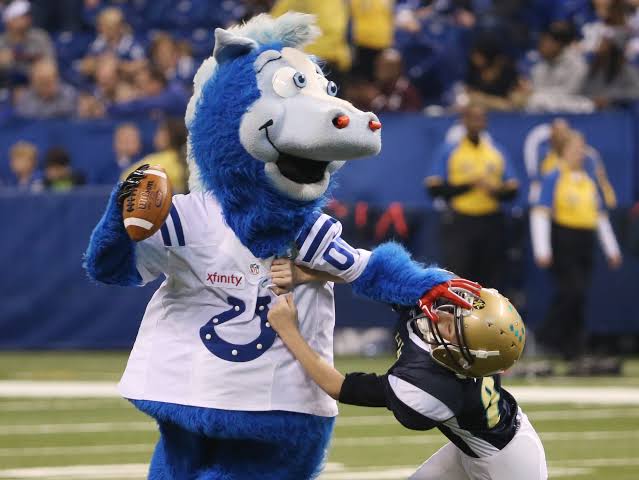
Blue has been the Colts' official mascot since 2006, but his evolution into a social media personality represents something quite different from his original role. Rather than simply appearing in matchday photographs, he has become the central character in a steady stream of short-form entertainment that has very little to do with American football. There are jokes, trends, interactions with other personalities and the kind of deliberately ridiculous behaviour that performs well on TikTok. Blue is recognisable, expressive and, crucially, does not need to explain himself. The costume does much of the work, while the person inside gives the character a personality that audiences across the world have come to recognise and seek out.
The Colts' own official account, by contrast, posts training camp footage, player features and match highlights. It is well-produced and professionally managed. It has 1.3 million followers. Blue is doing something fundamentally different: he has built an audience that extends far beyond people interested in the Colts or American football, because the content does not require that interest to be enjoyable.
A club's main social channels carry responsibilities that limit what they can do. They need to announce fixtures, communicate with existing supporters, promote commercial activity and maintain a certain level of consistency with the broader brand. Even when the tone is playful, there are limits to how far an official account can wander from the business of the organisation.
A mascot has considerably more freedom. Nobody expects Blue to provide thoughtful analysis of the Colts' offensive line, and nobody is disappointed when he spends an afternoon doing something completely unrelated to football. That creative freedom is commercially valuable in a way that is easy to underestimate. He can participate in internet culture, respond to trends and be genuinely surprising, without every piece of content feeling like a promotional exercise. The audience follows because the content is entertaining. The fact that Blue belongs to the Indianapolis Colts comes afterwards, and for many of his 9.4 million followers it may still be relatively incidental to why they follow him.
That is not a weakness. It is the mechanism by which the Colts reach people they would otherwise never reach.

The Philadelphia Flyers' Gritty arrived in 2018 to a reaction that was not universally enthusiastic. With his enormous orange beard, unsettling eyes and general appearance of having been discovered living beneath an abandoned fairground, he was hardly an obvious candidate for mainstream popularity.
But the character quickly became something far more interesting than a conventional hockey mascot. His appeal came partly from the Flyers' willingness to embrace the absurdity of his own existence. Rather than making him universally likeable, they let him become strange, mischievous and occasionally confrontational, a personality that felt entirely at home in the chaotic ecosystem of internet culture, where being memorable is often more valuable than being polished.

Before long, Gritty was appearing in conversations that had nothing to do with ice hockey. People who could not name a single Flyers player knew who he was, and the character became a recognisable part of Philadelphia's wider cultural identity. He did not simply give existing Flyers supporters something else to enjoy. He introduced the organisation to people who might otherwise have had no reason to encounter it at all.
That distinction matters. An audience built around a character is a different kind of audience from one built around match results. It is not dependent on form, league position or the quality of any given season, and it continues to grow whether the team is winning or not.
Football clubs have traditionally built their audiences around a fairly linear assumption. A child grows up watching matches, develops an attachment to a team, gradually becomes part of its supporter base, often through family connections or the influence of friends. That remains an enormously important route into supporting a club, but it is not the only one.
Somebody might become interested in a club because they enjoy its social media content, recognise a player from something unrelated to football or feel a connection to the people and culture surrounding it. The sport itself can come later. This is where the success of Blue becomes genuinely instructive. A person watching one of his videos does not need to understand the rules of American football, know where Indianapolis is or have any interest in the Colts' latest result. They simply need to find the video funny. If they follow the account, the Colts have established a connection with somebody they might never have reached through conventional sports marketing. Over time, that person may become more familiar with the team, its players and the wider organisation.
A million TikTok views cannot be treated as a million potential ticket buyers, and there is no guarantee that a viral video translates into meaningful commercial activity. But there is an obvious advantage in having an entertaining character capable of reaching people who would never think to follow a club's official account, and the value of that reach compounds over time.
The commercial contribution of a mascot is more complicated than follower counts suggest, and it is worth thinking about across several dimensions.
For the Colts, a character with 9.4 million TikTok followers creates opportunities for sponsorship, merchandise, brand partnerships and community appearances that would simply not exist without that audience. Blue also gives the club a second personality through which to communicate, often in situations where a conventional marketing message would feel forced or out of place.
The relationship with younger supporters and families is particularly important. A child attending their first sporting event may have little understanding of the competition, the players or the significance of the result. They may not remember much about the match itself. But they might remember meeting the mascot, having a photograph taken or watching it do something ridiculous in front of the crowd. That experience can become part of the reason they want to return, and return again after that. For clubs, this is a reminder that the value of attending live sport extends well beyond what happens on the pitch, and a mascot can play a surprisingly significant role in creating the moments that make an afternoon memorable.
It would be easy to look at Blue's success and conclude that the lesson for smaller clubs is to start producing more mascot content. That would be a superficial reading of what the Colts have achieved.
Blue benefits from the resources of an NFL franchise, an established character and a content operation capable of producing material consistently. Those advantages are not readily available to a National League club with a small commercial team and a volunteer who spends Saturday afternoons dressed as a badger.
But smaller clubs have genuine advantages of their own. They are often deeply connected to their local communities, with traditions, personalities and a sense of humour that larger organisations can struggle to replicate. A mascot that becomes a familiar figure in local schools, community events and businesses is creating relationships with people who might not otherwise have much contact with the club, and those relationships have value that does not always show up in follower counts.
Social media also offers an opportunity to extend those relationships beyond matchday without an enormous production budget. A mascot does not need a content team to become entertaining. It needs a recognisable personality, a little creative freedom and someone who understands what makes the character funny or interesting. That might mean appearing alongside players, visiting local businesses, getting involved in community events or developing a running joke that supporters begin to look forward to.
The important thing is that the content should feel like entertainment rather than another announcement delivered by somebody wearing an oversized head. Clubs should also resist measuring success entirely through viral moments. A mascot that becomes a genuinely loved part of the local community may be doing excellent work without ever attracting millions of followers.
For many organisations, helping a few more families feel comfortable attending their first match is a considerably more meaningful outcome than a video that reaches people on the other side of the world who will never buy a ticket.
The rise of Blue and Gritty reflects a wider shift in the relationship between sports organisations and their audiences. For a long time, clubs could reasonably expect supporters to seek them out. People wanted results, fixtures, team news and tickets, and the club was the natural place to find those things. Today, sports organisations are competing for attention alongside almost every other form of entertainment, and their next supporter may be watching a comedy sketch, following a musician or scrolling through videos with no particular interest in sport.
The most successful mascot strategies work because their characters have distinctive personalities that people recognise and return to. Blue is still unmistakably part of the Indianapolis Colts. Gritty is inseparable from the Philadelphia Flyers. Their success has not required either organisation to become something it is not, but it has allowed both to reach audiences through something other than the sport itself.
There is an obvious commercial opportunity in that. Although it should not obscure the simpler explanation for why mascots have remained part of sporting culture for as long as they have. They are fun. They make children laugh, give adults something to smile about and occasionally provide a welcome distraction from whatever is happening on the pitch.
The difference now is that a good mascot no longer has to wait until Saturday afternoon to do any of those things. The next generation of supporters may not discover a club through a spectacular goal, a famous player or even a football match. They might discover it because somebody dressed as a horse made them laugh on a Tuesday afternoon.
In a world where winning people's attention has become genuinely difficult, that is not such a ridiculous place to start.