The Clubhouse
How Caledonia Gladiators Are Building a Year-Round Audience
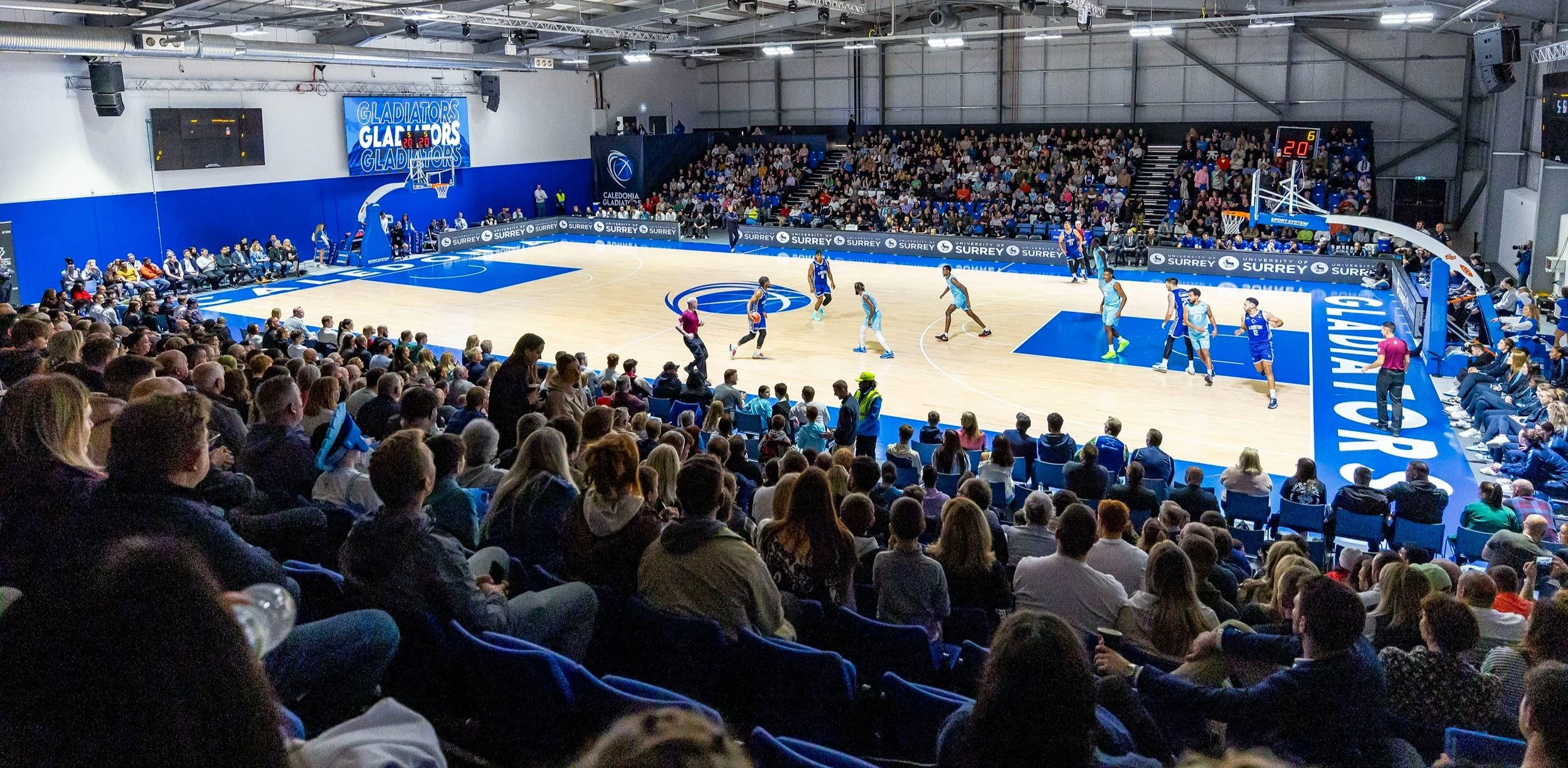


Caledonia Gladiators have spent the last few years building something most basketball clubs in the UK cannot claim: a venue they own, a growing events calendar and an audience that extends well beyond the sport itself.
The next stage is more ambitious.
For the club, the focus is no longer simply on selling as many tickets as possible for the next fixture. It is about understanding who is coming through the doors, what else they might be interested in, how often they return and how the arena itself can become a year-round destination rather than a building that comes alive only when basketball is being played.
That shift matters because the Gladiators are in a position that very few basketball clubs can replicate. They have their own venue, they have control over when and how it is used, and they are increasingly building an events business around it. Basketball remains at the heart of the operation, but boxing, kickboxing, Irish dancing, netball and major watch parties are helping the organisation reach entirely new audiences, while creating new commercial opportunities outside the traditional season.
For Pippa McAllister and the team, the lesson from the last few years is that getting people into the building is only the beginning.
"Data is top of the list," she says.
Filling the Arena
The starting point is still relatively straightforward. The Gladiators want as many people as possible at every home game, with an internal target of around 1,400 to 1,500 spectators for a full arena.
Basketball, though, creates a different challenge to sports where fixture choice is driven by rivalry, league position or the identity of the opposition. The Gladiators have a committed core support, but a significant part of their audience is more casual, often making the decision to attend because they are looking for something to do with friends or family.
As Pippa explains, "We have a handful of hardcore fans and the rest of them are really people that go, what are we doing on Sunday? Are the Gladiators playing? Let's go and see them."
That has shaped the way the club approaches ticket sales. Community outreach has been central, as have promotional offers, discounted tickets and partnerships with schools, local organisations and sponsors. In some cases, the calculation is simple. An occupied seat, even at a lower ticket price, can still generate food, drink and merchandise spend, while introducing somebody new to the Gladiators.
It is an approach that became particularly important during a period when household budgets were under pressure and live sport was increasingly competing with other forms of entertainment.
"I think the money's tight with people and families and something like basketball coming to a sport and events are luxury," Pippa says. "It's not just five pound a ticket they end up paying. By the time you get something to eat and something to drink and your child drags you to the merchandise shop, it probably comes to quite an expensive day out."
That does not mean discounting without a plan. Increasingly, the Gladiators are thinking about the lifetime value of somebody who comes through the door, rather than judging success solely by the initial ticket price.
Turning Community Into Audience
One of the most successful examples of that thinking is the Gladiators' Community Challenge, an initiative designed to bring local schools, clubs and community organisations directly into the matchday experience.
Groups are invited to perform on court, whether through dance, singing, gymnastics or other activities, with each selected organisation effectively becoming the Community Challenge group for that particular game. They are photographed with the team, featured in the fan zone and given an experience that extends beyond simply watching the basketball.
The performances themselves might last only a few minutes, but the commercial impact can be considerably broader.
"In our mind, it also then says, well, mum and dad and granny want to come, they'll buy a ticket," Pippa explains. "So it's about the community and welcome and doing something for them. But, yeah, it's also about ticket sales as well."
The value is not only in the additional attendance on the day. Each school, club or organisation represents a new relationship, another group of local people who can be invited back, and another audience that the Gladiators can learn more about over time.
That is increasingly how the club sees community activity, not as something detached from commercial growth, but as one of the ways that growth happens.
The same philosophy is visible across the matchday experience. The Gladiators have invested in fan entertainment, mascots, music, competitions, merchandise activations and family-friendly food and drink options, all designed to make attending a game feel like a full event rather than simply four quarters of action.
A dedicated children's kiosk, offering milkshakes, slush drinks and confectionery, was introduced towards the end of last season. Additional screens around the fan zone are being used to promote products and offers more effectively, while further investment in food and hospitality is intended to give the club much greater flexibility around different types of fixtures and audiences.
Growing the Women's Game
The growth of the Gladiators' women's team has provided another important strand of the attendance story.
In the earlier years, the club would sometimes open only one seating block for women's fixtures. That has changed. Both blocks are now regularly in use and, according to Pippa, women's attendances may have exceeded the men's overall during parts of last season.
Strong performances on court helped, with the team reaching finals in both London and Birmingham, but the increase in support also reflects the wider effort being made to build an occasion around each fixture.
The challenge now is to understand more clearly how audiences move between the men's and women's games, whether supporters who currently favour one can be encouraged towards the other, and whether double-headers or combined ticketing products can increase attendance across both teams.
That is exactly the kind of question the Gladiators now want their data to answer.
From Empty Weekends to a Full Events Calendar
The most significant change away from basketball has been the development of the arena as an events venue in its own right.
The doors were first opened to external events in October 2023, when the venue hosted a St Andrew's boxing event. At that point, much of the process was still new, but the event became a proof of concept. The organisers returned, other promoters took notice and the calendar began to grow.
Today, the picture is very different.
"From September through to May, I will either be working every weekend with an event or basketball," Pippa says. "We don't have any free spaces now."
The variety is as important as the volume. Boxing and kickboxing remain part of the programme, but they now sit alongside Irish dancing, gymnastics, schools events, netball and other competitions. Some organisers are rebooking almost immediately, while future bookings already stretch several years ahead.
That creates a very different commercial model for the venue. Instead of relying almost exclusively on basketball dates, the Gladiators are building multiple reasons for people to visit, with each event introducing another audience to the building.
The next target is the working week. Weekends between September and May are increasingly full, so attention is turning towards conferences, exhibitions, product launches and other Monday-to-Friday uses, particularly within the fan zone and hospitality spaces.
The principle behind it is simple.
"We're really proud of it," Pippa says of the venue. "But it can't be empty. So we just basically have to fill it every single day of the week."
Making June Matter
Perhaps the clearest example of how far the events strategy has developed came during June, traditionally a difficult month for an organisation whose core basketball season had finished.
Instead of accepting a quieter period, the Gladiators packed the calendar.
There was boxing, a multi-day Irish dancing event and a series of World Cup fan-zone nights, with one of those watch parties attracting around 1,400 people to the venue and another drawing approximately 900.
The first major fan-zone event brought its own operational challenges, particularly around bar demand, but it also gave the team an opportunity to learn quickly. By the second event, processes had already been tightened and the experience was smoother.
More importantly, it transformed a month that could otherwise have produced relatively little activity.
"If you look at June's takings, it's amazing," Pippa says.
The financial value was only one part of the result. Thousands of people had visited the venue, many of whom were football fans rather than basketball supporters and may never previously have had a reason to walk through the doors.
The Gladiators deliberately positioned the watch parties as family events rather than city-centre-style fan zones, bringing in live music, children's entertainment and inflatables to create something that felt appropriate to the local audience.
In doing so, they gained exposure to an entirely different section of the community and, crucially, another potential customer base.
Why Owning the Relationship Matters
That point leads to one of the clearest lessons the Gladiators have learned.
During the previous season, the club experimented with discounted ticket platforms in an attempt to increase attendance at more difficult fixtures. In pure occupancy terms, the tactic worked. Some games gained an additional 400 or 500 spectators.
The problem came afterwards.
Because the purchase had taken place through a third party, the Gladiators had limited access to the customer data. Ticket collection became manual, queues were created around printed tickets and reference numbers, while the club was left without an effective way of communicating with many of those supporters once the event was over.
"It worked to get bodies in, but it didn't work for data capture," Pippa says.
That experience has influenced how the Gladiators now think about ticketing beyond basketball too.
Their Irish dancing event in June was the first external event to run entirely through Fanbase, with all ticket sales processed through the platform. The intention now is to use Fanbase across the venue's wider programme of ticketed events.
"Our plan is to use fan base for all our ticketed events," Pippa says. "It just means that we have a tighter control. We can make a little bit of money. Security wise, we scan them in and it's just. And we're collecting data, which is the all important thing for us as well."
The difference is significant. Selling the ticket is one transaction, but knowing who purchased it creates the opportunity for another.
A family that attends Irish dancing might be interested in a future arena event. Somebody who comes to a World Cup watch party might be persuaded to attend a Gladiators fixture. A parent buying four individual tickets across the course of a season might be better suited to a season ticket. A supporter who regularly attends the men's team could be introduced to the women's team, or vice versa.
None of that happens automatically. It depends on knowing who those people are.
Moving From Collection to Action
The Gladiators have always gathered data through ticket sales, but Pippa is candid about the fact that the organisation has not always had the time or resources to use it as effectively as it could.
For several years, the priority was operational, making sure tickets were on sale, getting fixtures promoted and concentrating on attendance. With new people now joining the commercial and marketing teams, that is starting to change.
"It's probably an area that we've talked about for the three years that we've had it, but we've not really concentrated on it," she says. "Lean team, we've just been trying to get bums on seats."
The next phase is about connecting those two things.
"Bums and seats is down to data and how we do the Outreach to them."
That means identifying previous buyers, understanding buying patterns, segmenting audiences properly and creating more relevant reasons for people to return.
If somebody attended four games last season, should they be offered a season ticket? If a family first encountered the venue through a community event, can they be brought back for basketball? If somebody bought tickets for a women's fixture but never attended the men's team, is there an offer capable of changing that behaviour?
The questions become more interesting as the Gladiators' audience grows beyond basketball, because the organisation is no longer dealing with one database built around one type of customer. It is gradually building an audience across sport, entertainment, hospitality and community activity.
A Venue That Can Adapt
The physical development of the arena is following the same logic.
A new 120-seat licensed dining space is being introduced, giving the venue greater control over its food and hospitality offering and allowing packages to change depending on the fixture or event.
For Pippa, that flexibility is important. A Friday night game might lend itself to a more informal food-and-drink package, while a Sunday double-header could create an opportunity for brunch between the women's and men's fixtures.
The previous catering model was more structured, with less ability to adapt menus or offers around individual events. Bringing more of that operation in-house should allow the Gladiators to respond more closely to what different audiences want.
There are ambitions beyond food too. With weekends increasingly occupied and the core events operation established, Pippa is already thinking about music nights, tribute acts and Q&A events, particularly those with greater potential for bar and hospitality spend.
"We can't sit still purely relying on basketball," she says.
The Next Stage
The next season will be less about proving that the model works and more about making it smarter.
The Gladiators already know they can attract strong crowds, they know external events can fill the venue during periods when basketball is not being played, and they know community activity can drive both engagement and ticket sales.
The opportunity now is to connect those different audiences more effectively.
For the men's and women's teams, that could mean stronger cross-promotion, more targeted offers and better use of double-headers. For events, it means turning first-time visitors into repeat customers rather than allowing the relationship to end at the door. For hospitality, it means building offers around the type of event, the time of day and the people attending rather than relying on one fixed package.
Most importantly, it means moving beyond having customer data and towards actually using it.
The Gladiators' experience is one that will be familiar to plenty of sports organisations. For years, the immediate challenge is simply filling the venue, selling enough tickets and making each event work. Once that starts to happen consistently, the question changes.
Who are all these people, what else might they want, and how do you give them a reason to come back?
For Caledonia Gladiators, that is now the priority.
"Data is top of the list."